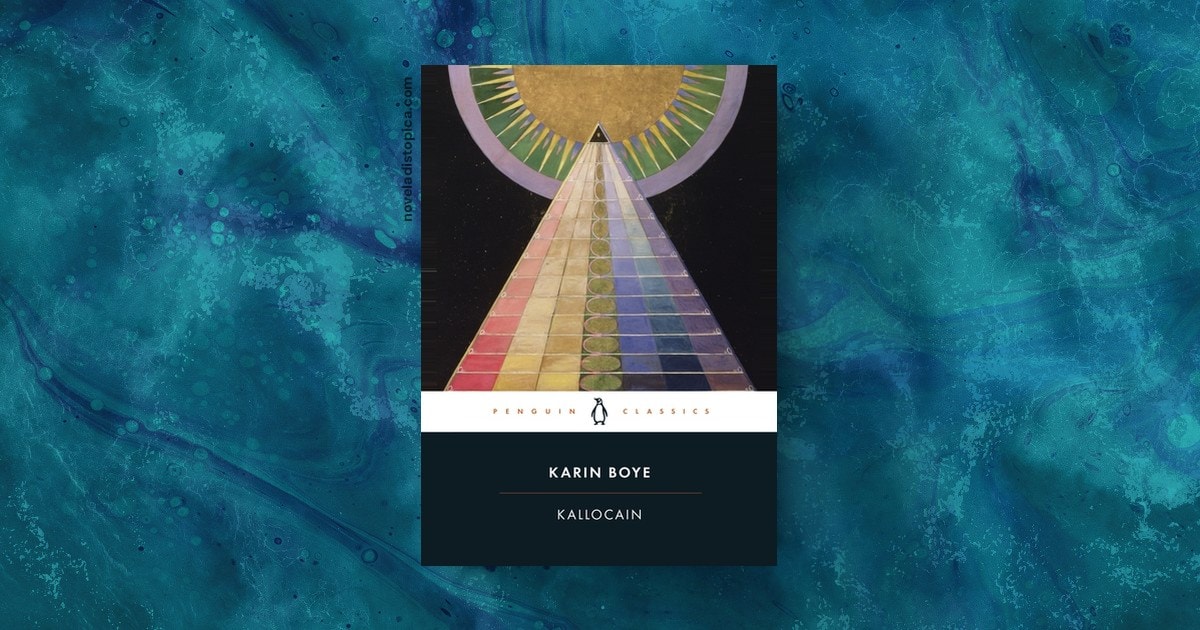
🔤 Original title: Kallocain. Roman från 2000-talet («A Novel from the 21st Century»)
✍️ Author: Karin Boye
📅 First published: 1940 (Bonniers, Sweden)
🏢 English edition: Penguin Classics, 2023 paperback (first Penguin edition 2019)
🌐 Translator: David McDuff, with his introduction (earlier translation: Gustaf Lannestock, 1966)
📄 Pages: 192
🔢 ISBN: 978-0-241-60830-2
📚 Genre: Dystopian novel · political and psychological science fiction
🏆 Awards: finalist for the 1941 Retro Hugo for Best Novel (awarded in 2016)
🎬 Adaptation: Swedish television miniseries (1981)
⭐ Rating: 8.5/10
Kallocain (1940) is a dystopian novel by the Swedish poet Karin Boye about a chemist who invents a truth serum, and about the World State that turns it into a tool for prosecuting thoughts. It came out nine years before 1984, and Boye died the following spring, so she never saw how far it would travel. Our verdict: 8.5/10, the most intimate of the classic dystopias and the one most readers have never heard of.
Below: a spoiler-free summary, the key themes and weak points, the ending (clearly marked), the comparison with 1984 and which English translation to read.
Kallocain summary (no spoilers)
The Swedish subtitle sets the scene: this is a novel of the twenty-first century. The world belongs to the World State, a regime permanently at war, or preparing for war, with its neighbor, the Universal State. For fear of air raids, people live in specialized underground cities cut off from one another, and going up to the surface takes a permit. Every citizen is first of all a «fellow soldier»: work by day, military service in the evening, and no private life beyond what the State allows.
Leo Kall is a chemist of about forty, working in a city devoted to the chemical industry, and he is a model citizen. He sees life as a ladder to climb as fast as possible, with rivals close behind. His great invention is a drug that, once injected, makes anyone say exactly what they think and feel. He names it after himself: Kallocain.
Leo tests it on volunteers from the Voluntary Sacrifice Service, under the eye of his superior, Edo Rissen, a man he distrusts on instinct. The city’s police chief is soon interested, and then the Ministry of Propaganda asks for the drug in quantity. Early on, over dinner at home, with Linda and the children at the table, he explains to the household’s domestic helper why the serum is legitimate:
«Does not the whole of the fellow soldier belong to the State? To whom would his thoughts and feelings belong, if not to the State?»
Karin Boye, Kallocain, translated by David McDuff (Penguin Classics)
The confessions, however, are not what he expected. Most of the people he interrogates are not hiding sabotage plans. They reveal something far more unsettling to him: a longing to trust another person, to live in the open air, to go unwatched. Some mention a secret group with its own rituals and a murdered man they remember as a martyr. At home, meanwhile, Leo watches his wife, Linda, with a jealousy he cannot even name.
Leo tells the whole story more than twenty years later, from prison. You know that from the first page; how he got there is the novel. He opens by admitting that he does not quite know why he is writing, only that he has to: «I will and I must, and that is all,» in McDuff’s translation. Kallocain is not the story of a rebel. It is the story of a loyal man whose own invention teaches him exactly what he did not want to know.
Key themes in Kallocain
The setting is the stock furniture of its era. What sets the book apart is where Boye points the camera: at the mind and the marriage of a committed civil servant.
A state that criminalizes thought
Control in the World State is already suffocating before Kallocain exists. The police have eyes and ears in every apartment, each household has a domestic helper who reports what she sees, anyone can denounce a neighbor, and children are handed over to the State’s camps at seven. The one thing the regime cannot reach is what people leave unsaid.
The serum closes that last gap. Once it exists, surveillance no longer stops at behavior: intentions and emotions can be prosecuted before they become acts. You no longer have to do anything; it is enough to have felt it. Boye’s point is that a totalitarian state cannot coexist with an inner life, and that sooner or later it will come for it.
Leo Kall, a narrator on the State’s side
Leo does not start as a dissident. He wants promotion, he fears his neighbors, and he translates his insecurity about his marriage into the language of political loyalty: if Linda is hiding something, that is a matter for the State. This turns the book into something more complicated than a chase between power and a rebel. The persecutor and the persecuted live inside the same man.
His change comes from listening. The drug that was supposed to prove everyone guilty shows that everyone needs someone to trust. Boye is careful not to make him a hero: Leo remains petty, jealous and cowardly almost to the end, which is exactly why his slow shift is believable.
Truth, privacy and consent
Boye does not treat every truth as liberating. A confession extracted chemically strips away context, will and the relationship with whoever is listening. Telling the truth because someone else controls your body does not build trust; it makes trust impossible. That is the paradox the book rests on, because what the subjects confess is precisely that they miss a truth given freely.
Swap the syringe for systems that infer your opinions or your «risk» from what you do on your phone, and the question still stands: can a society punish someone for an inner life they never chose to share?
Where it falls short
The world outside Leo’s head is only sketched. You learn little about how its cities, ministries and war actually work, and readers expecting the machinery of 1984 will go hungry. The middle section, one experiment after another, repeats itself, and the secret group glimpsed in the confessions stays deliberately vague. The prose is introspective, with long sentences, and the first chapters ask for patience. None of this sinks the book, but it is worth knowing before you start.
Kallocain ending explained (spoilers)
Warning: this section gives away the ending. If you have not read the novel, skip to the comparison with 1984.
Leo’s crisis breaks at home. Unable to bear the doubt, he injects Linda with Kallocain, and what he hears disarms him: she too wants to escape the State, and what gives her life meaning is not the State but their children and the life they have built. The «anti-State» tendencies Leo hunts in others live in his wife and in himself.
He reports Rissen to the police anyway, and the machinery he helped oil does the rest. One evening Linda does not come home. Then the Universal State invades the city, and Leo is taken prisoner by a regime that is a mirror image of his own. There he goes on making Kallocain, now for the enemy.
The book you are reading is the one he writes in that prison, decades later, with no news of his wife or children. His last memory is the night he was captured, when for the first time he noticed the natural world around him and felt more human than ever. The ending of Kallocain offers no political way out, because the enemy is an identical state, but it does leave a private crack: the man who started out climbing ladders ends up writing a book nobody asked him for.
Kallocain vs 1984, We and Brave New World
The obvious comparison is with George Orwell’s Nineteen Eighty-Four (1949): a world state at permanent war, surveillance inside the home, and thought itself as the crime. Orwell almost certainly never read Boye, since the novel did not appear in English until 1966, long after his death, as the Encyclopedia of Science Fiction points out. The difference is in the method. What O’Brien achieves with torture in Room 101, Leo Kall achieves with an injection. Richard B. Vowles, introducing the 1966 translation, made the same point: Orwell keeps physical torture when subtler tools are available. Kallocain is shorter and more domestic than 1984; it describes the apparatus of power far less, and the effect of fear on a marriage far more.
The closest relative is Yevgeny Zamyatin’s We (written 1920–21): both are the record of a loyal scientist who cracks from the inside, and in both the State reaches into private life. But where Zamyatin builds a glass city in which everything is visible, Boye buries her characters underground and watches them from within. Whether she had read We is disputed. NPR’s review of the Penguin edition states that she had read Zamyatin and Huxley; her Swedish biographer Johan Svedjedal found nothing to show she knew We when she wrote the book.
With Aldous Huxley’s Brave New World (1932) it shares chemistry as a means of government, used in opposite directions. Huxley’s soma keeps people from wanting to rebel. Boye’s serum finds out who does.
Is Kallocain worth reading?
If you have read Orwell, Huxley and Zamyatin and want the piece that is missing, yes. If you care more about people than systems, also yes: Kallocain is above all the portrait of a marriage under a regime that leaves no room for intimacy. Reviewing the Penguin edition for NPR in 2023, Ilana Masad argued exactly that: relationships, not the dystopian set, are the real heart of the novel. It is short, it reads in two or three sittings, and it stays with you.
If you want action, chases or a world built in detail, it will probably feel thin. Almost everything happens in a laboratory, a dining room and Leo’s head.
Swedish critics welcomed it in 1940, and the writer Artur Lundkvist called it a novel «of international class.» Vowles wrote that it «deserves to take a secure place in the literature of dystopia,» next to Huxley and Orwell. It was adapted as a Swedish television miniseries in 1981, it was a finalist for the 1941 Retro Hugo for Best Novel (awarded in 2016, when A. E. van Vogt’s Slan won), Penguin brought it into Penguin Classics with McDuff’s translation, and in 2025 it was named to the cultural canon commissioned by the Swedish government.
Our verdict on Kallocain: 8.5/10
The plain prose and the retrospective confession keep the tension up without big set pieces. The outside world is schematic and the run of experiments drags, but few dystopias have understood so clearly that totalitarianism does not stop at controlling the street. It wants to govern the space between a thought and the words that would express it.
An essential, compact novel that fills in what the canon of Orwell, Huxley and Zamyatin leaves out: intimacy, guilt and the fear of trusting anyone. Rating: 8.5/10.
About Karin Boye
Karin Boye was born in Gothenburg on October 26, 1900, and grew up in Stockholm. She studied at Uppsala University, published her first collection of poems, Moln («Clouds»), in 1922, and was active in Clarté, a socialist and anti-fascist group. In Sweden she is remembered first as one of the great poets of the twentieth century; «Ja visst gör det ont» («Yes, of course it hurts») is one of the best-known poems in the language.
She also wrote novels, among them Astarte (1931) and Kris («Crisis,» 1934), about her religious crisis and her realization that she loved women. She spent time in Berlin in the early 1930s, where she met Margot Hanel, her partner for the rest of her life. What she saw in Nazi Germany and on a trip to the Soviet Union fed directly into Kallocain, which she began in 1939 and finished in the summer of 1940. In April 1941 she left her home in Alingsås after taking sleeping pills and was later found dead on a nearby hill. She was forty.
Frequently asked questions
What is Kallocain about?
Kallocain is about Leo Kall, a chemist in a totalitarian World State who invents a truth serum to expose disloyal citizens. The confessions he collects reveal a hidden longing for trust and freedom, and the drug ends up inside his own marriage. It is a dystopian novel by Karin Boye, published in Sweden in 1940.
What does «Kallocain» mean?
Kallocain is the name of the truth drug in the novel, and its inventor names it after himself: Kall plus a pharmaceutical-sounding ending that echoes drugs such as cocaine. In Swedish, «kall» also means «cold,» a coincidence that suits its narrator. The original title is the same word.
How does Kallocain end?
Kallocain ends with Leo Kall in prison. After injecting his wife and denouncing his superior, he loses Linda, and when the rival Universal State invades, he is captured and made to produce Kallocain for the enemy. He writes the book decades later, with no news of his family, remembering the night of his capture as the moment he felt most human.
Is Kallocain like 1984? Did Orwell read it?
Kallocain shares the core of 1984: a world state at war, surveillance in the home and thought as a crime, and it was published nine years earlier. Orwell almost certainly did not read it, because there was no English translation until 1966. Boye focuses on confession, marriage and trust; Orwell describes the machinery of power in much more detail.
Which English translation of Kallocain should I read?
The current English translation of Kallocain is David McDuff’s for Penguin Classics (2019; paperback 2023, 192 pages, ISBN 978-0-241-60830-2), with his introduction. The earlier translation by Gustaf Lannestock, published by the University of Wisconsin Press in 1966 with an introduction by Richard B. Vowles, is still found in libraries and secondhand.
If you liked Kallocain
The natural next steps are the three books it is always compared with: Zamyatin’s We if you want the closest ancestor, Nineteen Eighty-Four if you want the thought crime taken to its limit, and Brave New World if the chemistry of obedience is what caught you. Arthur Koestler’s Darkness at Noon, also from 1940, makes a sharp companion: another novel about how a regime manufactures confessions. For the opposite bet, a community that shapes what its members want and calls the result happiness, try B. F. Skinner’s Walden Two (1948).
If someone could hear everything you think, who would you be? Boye puts that question to her narrator and never quite lets the reader off either. More classic dystopias and utopias are waiting in our reviews in English.