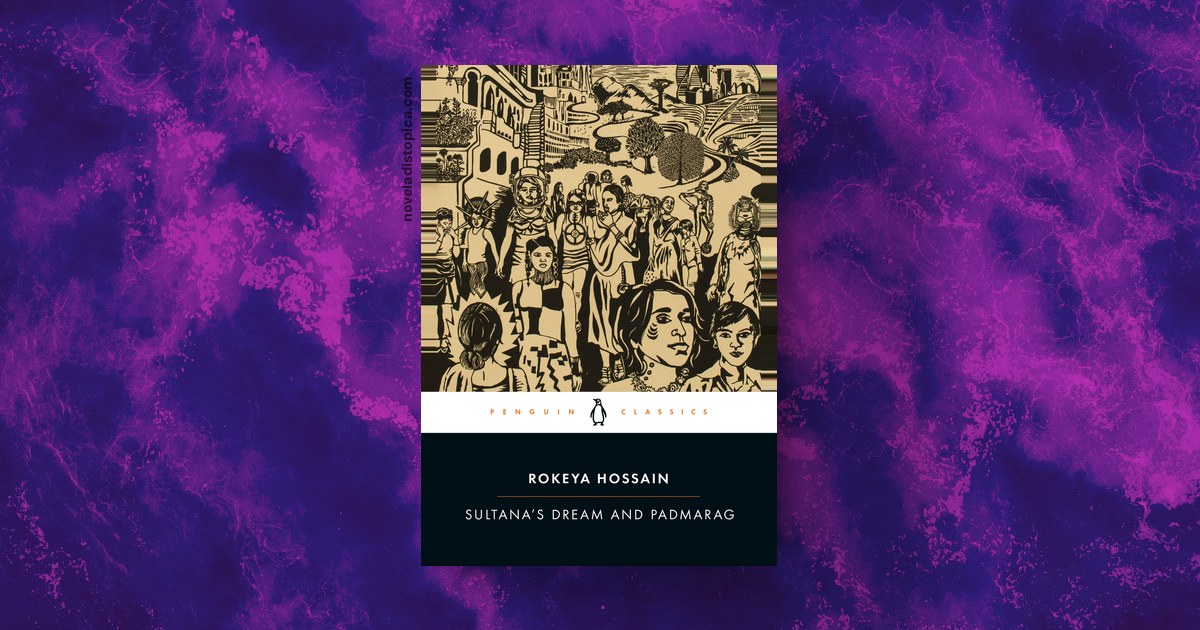
✍️ Author: Rokeya Sakhawat Hossain (Begum Rokeya)
📅 First published: 1905, in The Indian Ladies’ Magazine (Madras) · in book form, 1908
🏢 English edition: Sultana’s Dream and Padmarag, Penguin Classics, 2022 (introduction by Tanya Agathocleous; Padmarag translated from Bengali by Barnita Bagchi)
📄 Pages: 240 (with Padmarag); the story alone is about 4,000 words
🔢 ISBN: 978-0-14-313705-4
📚 Genre: Feminist utopia · early science fiction · short story
🏆 Recognition: UNESCO Memory of the World Register for Asia and the Pacific (2024)
🎬 Adaptations: Sultana’s Dream (2023), animated film by Isabel Herguera
⭐ Rating: 8/10
In Rokeya Sakhawat Hossain’s 1905 short story Sultana’s Dream, a Bengali woman who lives in purdah dreams that she visits Ladyland, a country where women run the government and the sciences and men are kept indoors, exactly as Indian women were kept in the zenana. Her guide, Sister Sara, explains how the women took over without firing a shot: they educated themselves, learned to harness the sun and used it to drive off an invading army. Here is a short Sultana’s Dream summary, then what it means.
Hossain wrote it in English, at about 25, ten years before Charlotte Perkins Gilman’s Herland. It is short, in the public domain and still funnier than most of the utopias that followed. Below: the plot, the characters and themes, how it reads next to Herland and The Handmaid’s Tale, and our verdict.
Sultana’s Dream summary: a walk through Ladyland
One evening the narrator, Sultana, is lounging in an easy chair in her bedroom, «thinking lazily of the condition of Indian womanhood.» A woman she takes for her friend Sister Sara invites her to see her garden. Outside it is broad daylight, and Sultana, who has never walked about unveiled, is mortified. Then she notices that there is not a single man in sight.
Passers-by laugh at her: she looks «mannish,» her guide explains, meaning shy and timid. Where are the men? «In their proper places, where they ought to be.» This is Ladyland, where men live shut away in the mardana, cooking and minding the babies, while women run the offices, the laboratories and the streets.
The rest is a guided tour with a history lesson attached. Sara shows Sultana a kitchen that cooks with concentrated sunlight, fields tilled by electricity, a captive balloon that draws water from the clouds and an air-car lifted by hydrogen balls. Then she explains the history. A young queen who loved science made education compulsory for women and banned marriage before 21, and two women’s universities competed to invent new technologies. The military men called it all «a sentimental nightmare.» Then a neighboring king declared war because the queen refused to hand over political refugees, and the army lost.
With the enemy 25 miles from the capital, the head of the second university set one condition: that the men withdraw into the zenana. Wounded and exhausted, they obeyed. She then marched out with two thousand students and turned the stored heat of the sun on the invaders, who fled. The men have stayed indoors ever since. Sultana meets the queen and, as the air-car takes off again, falls and wakes up in her easy chair.
Sultana’s Dream does not imagine a world without men. It imagines the same world as 1905, with the lock on the other side of the door. The full text is free to read at A Celebration of Women Writers (University of Pennsylvania), and it takes about twenty minutes.
Sultana’s Dream characters
Sultana, the narrator
Sultana is a woman in purdah, apparently from Calcutta (Sister Sara speaks of «your Calcutta»), and the reader’s stand-in. She brings every argument her society uses to justify seclusion (women are weak, the streets are unsafe, men’s brains are bigger) and watches each one fall apart. Her name is a name, not a title: she is not a sultan’s wife.
Sister Sara, the guide
Sister Sara is the key character, and she is not who Sultana thinks. Sultana takes her for an old friend from Darjeeling, realizes she is a stranger, and keeps calling her Sister Sara anyway. She works in a laboratory, finishes her office work in two hours and is the story’s debater, patient and ironic. When Sultana says women stay indoors because they are naturally weak, Sara asks whether, if lunatics escaped from an asylum, anyone would lock up the sane instead.
The Queen and the Lady Principals
The Queen came to the throne at thirteen, loves science and wants to turn the country into one great garden. She refuses to give up refugees, which starts the war. The two Lady Principals who run the universities drive the plot: one invents the water balloon, the other the solar weapon that wins the war. The men never speak; they are only reported on.
Key themes of Sultana’s Dream
Purdah turned inside out
Purdah meant the seclusion of women: living in the zenana, the inner part of the house, and never being seen by men outside the family. Hossain does not describe it; she reverses it. «We shut our men indoors,» Sara explains. The reversal is more than a joke: it forces the reader to see the custom as imprisonment justified by the weakness of the people it imprisons. Sara’s reply to the strength argument is one of the best lines in the story: «A lion is stronger than a man, but it does not enable him to dominate the human race.»
Science against militarism
Ladyland changes because women are educated, not because they take up arms. While the men build up military power, the women’s universities learn to pull water from the air and store the sun’s heat. The war, Sara says, was won «not by arms» but «by brain»: knowledge beats weapons. For 1905, the technology is striking: solar energy, electric farming and something close to a helicopter. UNESCO cited that foresight when it listed the story in 2024, as Down To Earth reported.
Satire, and a quiet attack on empire
Hossain is funny, which sets her apart from most utopian writers of her time. Sara explains why magistrates need seven hours for two hours’ work: if a man smokes twelve cheroots a day at half an hour each, he wastes six hours in smoke. When Sultana objects that men’s brains are bigger, Sara points out that an elephant’s brain is bigger still. Under the light tone sits a critique of empire. The Queen says Ladyland does not covet other people’s land or fight over diamonds «a thousand-fold brighter than the Koh-i-Noor,» nor grudge a ruler his Peacock Throne. Both were imperial spoils, the Koh-i-Noor by then in the British crown jewels.
Where it falls short
The first problem is that Ladyland does not abolish seclusion; it changes the tenant. Hossain knows it: when Sultana laughs at how the tables are turned, Sara answers, «But the seclusion is the same.» The story goes no further, and its ideal society is still organized around who may go outside. The second is that Ladyland’s peace rests on a weapon, and the story never stops to think about that. The third is form: there is no conflict and not a single woman who disagrees. Ladyland is built to persuade, not to be lived in, like most classic utopias.
How it was written, and how it was rediscovered
In 1898 Hossain married Syed Sakhawat Hossain, a deputy magistrate in Bhagalpur (Bihar), who encouraged her to read and write in English. By her own account, she wrote Sultana’s Dream to pass the time while he was away on tour and to show him how good her English was. He urged her to send it to The Indian Ladies’ Magazine, an English-language periodical in Madras, which published it in 1905; it came out as a book in 1908. Almost everything else she wrote was in Bengali.
Outside South Asia it took decades to travel. The Feminist Press in New York reissued it in 1988 with selections from The Secluded Ones, edited and translated by Roushan Jahan. Penguin India paired it with Padmarag in 2005, and Penguin Classics reissued that volume in 2022. In May 2024 UNESCO added it to its Memory of the World Register for Asia and the Pacific, and it is now widely taught in South Asia.
The Spanish animator Isabel Herguera turned it into a film, Sultana’s Dream (2023), which competed at San Sebastián, was nominated for the Goya for best animated film and won the Contrechamp Grand Prix at Annecy in 2024. It is not a straight adaptation: it follows Inés, a Spanish artist, on the trail of Hossain and Ladyland.
Reading Sultana’s Dream today: Herland, The Handmaid’s Tale and the feminist utopia
Sultana’s Dream belongs to a short line of utopias written by women. Before it came Mary E. Bradley Lane’s Mizora (serialized 1880–81), an all-female civilization inside the Earth. Ten years after it came Charlotte Perkins Gilman’s Herland (1915), a country without men for two thousand years whose women reproduce on their own. The resemblance is obvious: an isolated country, a society calmer and more rational than the visitor’s, and a patient guide fielding naive questions.
The difference is who writes and from where. Mizora and Herland, by two white American women, reach perfection by removing people: Mizora is uniformly blonde by design, and Herland perfects itself by steering the women it judges least fit away from motherhood. Hossain, a Bengali Muslim under British rule, needs no eugenics. The men are still there; what changes is who holds power and knowledge, and her utopia is built by opening schools. That is the main reason it has aged better than Herland.
The more interesting pairing today is with Margaret Atwood’s The Handmaid’s Tale (1985). Gilead is Ladyland’s mirror image: a regime that confines women, covers them and sorts them by function, and calls it protection. The argument Sultana repeats at the start of her dream (it is not safe for us outside, we are naturally weak) is the one Gilead’s Aunts preach. Together they make one point from opposite ends: seclusion is a technology of power, and it serves whoever holds the key. Hossain turned it around as a joke; Atwood, eighty years later, showed it working without the joke.
That is also where the limits show. Ladyland keeps purdah’s moral logic, from its cult of purity to its rules on which relatives may see whom, and only changes who is behind the curtain. Hossain’s aim was narrower than Joanna Russ’s in The Female Man (1975). She set out to show that the reasons for locking women up were absurd, and she did it in a few thousand words that still work. For more context, Mahvesh Murad’s essay for Reactor reads the story as a non-Western answer to the Anglo-American feminist utopia, and Joshua Glenn’s piece in The MIT Press Reader places it among early science fiction.
Is Sultana’s Dream for you?
Read it if you are studying it, but also if you read classic utopias and want to step outside the More, Bellamy and Gilman line, or if you are interested in early science fiction written outside Europe and the United States. It takes one sitting and gives a class or a book club plenty to argue about.
Skip it if you want a plot: it is one night’s walk with a guide who explains everything, and its pleasure lies in the answers. If you liked it, read Herland next, and Padmarag (1924), Hossain’s novel about a refuge for women of different faiths, in the same Penguin volume.
Verdict: 8/10
Sultana’s Dream is one of the sharpest and funniest feminist utopias of the early twentieth century: in a few pages it turns purdah inside out, puts science in women’s hands and uses simple questions to take apart the arguments used to keep them indoors. It loses points for its brevity, a society without conflict and a peace that depends on a weapon. We give it 8/10, not least because, unlike its American relatives, it does not build its ideal country on eugenics.
About Rokeya Sakhawat Hossain
Rokeya Sakhawat Hossain was born in 1880 in Pairaband, in the Rangpur district of what is now Bangladesh, into a Muslim landowning family. Girls in the family were not meant to learn Bengali or English, and it was her elder brother, Ibrahim Saber, who taught her both. Widowed in 1909, she opened a girls’ school in Bhagalpur with five pupils and moved it to Calcutta in 1911, where the Sakhawat Memorial Girls’ High School still operates. She kept writing in Bengali, including Padmarag (1924) and Abarodhbasini (The Secluded Ones, 1931), sketches on the cruelties of purdah.
She died in Calcutta on December 9, 1932. In Bangladesh the date is Rokeya Day, and in 2004 she came sixth in a BBC poll of the greatest Bengalis of all time. Outside South Asia she is still little known.
Frequently asked questions
What is Sultana’s Dream about?
Sultana’s Dream is about a Bengali woman living in purdah who, in a dream, visits Ladyland, a country run by women where men are kept indoors. Her guide, Sister Sara, explains how women used education and science to harness solar power, control the rain and win a war without an army.
What is the central theme of Sultana’s Dream?
The central theme of Sultana’s Dream is the injustice of purdah, the seclusion of women. By reversing it, so that men are confined and women run society, the story shows that the arguments for seclusion are absurd and that women’s education, not physical strength, is the source of progress.
Was Sultana’s Dream written in English?
Yes. Rokeya Sakhawat Hossain wrote Sultana’s Dream in English, partly to show her husband her command of the language. It was published in 1905 in The Indian Ladies’ Magazine of Madras and as a book in 1908. Most of her other work was written in Bengali.
Is Sultana’s Dream a short story or a novel?
Sultana’s Dream is a short story of about 4,000 words, sometimes called a novella. It can be read in about twenty minutes, and in print it usually comes with other texts, such as Hossain’s novel Padmarag.
Is there a Sultana’s Dream movie?
Yes. Sultana’s Dream (2023) is an animated film by the Spanish director Isabel Herguera, inspired by the story and by Rokeya Sakhawat Hossain’s life. It premiered at the San Sebastián Film Festival, was nominated for the Goya for best animated film and won the Contrechamp Grand Prix at Annecy in 2024.
Hossain wrote her utopia to pass the time and to prove a point about her English, and ended up asking a question nobody has quite finished answering: what would happen if custom changed sides? You will find more classic utopias and dystopias on our reviews in English page.