✍️ Author: B. F. Skinner
📅 First published: 1948 (Macmillan, New York)
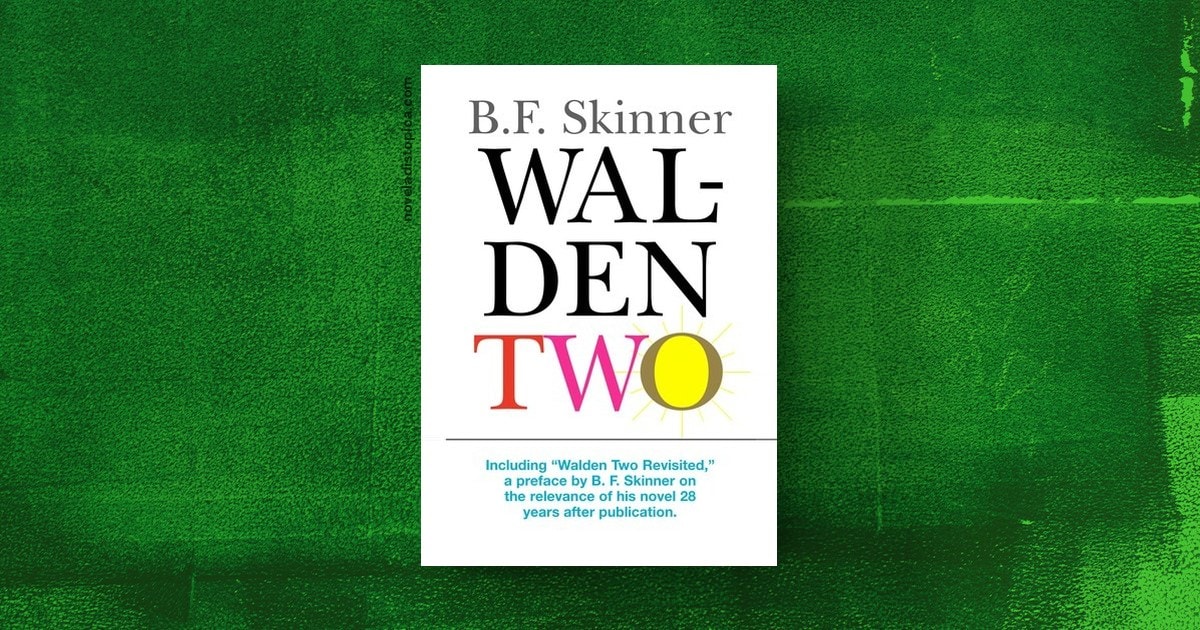
🏢 English edition: Hackett Publishing, 2005 (reprint of the 1976 Macmillan edition, with the preface «Walden Two Revisited»)
📄 Pages: 320
🔢 ISBN: 978-0-87220-778-3
📚 Genre: Utopian fiction · novel of ideas
🏆 Awards: —
🎬 Adaptations: —
⭐ Rating: 7.5/10
Walden Two (1948) is B. F. Skinner’s only novel: a portrait of a rural community of about a thousand people who work four hours a day, punish no one and are shaped from the cradle by the science of reinforcement. Skinner meant it as a utopia. Many readers finish it convinced they have read a dystopia, and the book is at its most interesting in the gap between those two verdicts.
As a story, it is thin: a guided tour and a long argument. As a thought experiment about control, it has aged better than the psychology behind it. Below: a spoiler-free summary of Walden Two, its ideas, the real communities it inspired and our verdict.
Walden Two summary (no spoilers): a few days inside Frazier’s experiment
It is shortly after the Second World War, in the United States. Professor Burris, a psychologist who narrates the book, gets a visit from two young veterans, Rogers and Steve Jamnik. One remembers Burris mentioning an old graduate-school acquaintance, T. E. Frazier, who had founded an experimental community in the countryside. Back from the war with no appetite for the life waiting for them, they want to see it.
Burris agrees to go and brings a far more skeptical colleague, the philosopher Augustine Castle. The veterans’ girlfriends, Barbara Macklin and Mary Grove, come along. For several days Frazier shows them around a farming community of nearly a thousand members, with shared dining rooms, workshops, nurseries and fields.
What they find unsettles them. Nobody earns a wage: members work an average of four hours a day for labor credits and spend the rest of their time studying, playing music or resting. Unpleasant jobs earn more credits per hour, so the sewers get cleaned without anyone being ordered to, an idea Frazier credits to Edward Bellamy. Children are raised in common. There are no police and no advertising. Six Planners, whom the members do not elect and who may serve up to ten years, run the place.
From there, the plot is an argument. Castle attacks, Frazier answers, Burris wavers and the younger visitors start taking sides, until each of them has to decide whether to stay. Walden Two does not ask whether a happy society can be built. It asks whether you would want to live in one that makes you happy on purpose.
Key themes in Walden Two
Nearly eighty years on, the book still provokes people. To see why, look at what Frazier is selling and how Skinner lets him sell it.
Behavioral engineering, without the jargon
The engine of the novel is operant conditioning, Skinner’s great laboratory finding. It fits in one line: behavior followed by a pleasant consequence tends to be repeated. Skinner studied it with rats and pigeons in a chamber where pressing a lever or pecking a key released food. His best-known conclusion: reinforcement works far better than punishment, which only suppresses behavior while the threat lasts.
Walden Two applies the principle to a whole society. «It’s simply a matter of behavioral engineering,» Frazier says when the visitors ask how the community has all but eliminated jealousy. The most quoted example is the self-control training given to children of three or four. In Frazier’s words: «We give each child a lollipop which has been dipped in powdered sugar so that a single touch of the tongue can be detected.» If it is still untouched later in the day, the child may eat it; meanwhile the children learn the tricks for not wanting it. The Walden Code even discourages members from thanking one another personally, since the credit belongs to the community.
If this sounds familiar, it is because you carry it around: notifications, likes and streaks run on the same logic. The difference is that in Walden Two the design is done in the open and, in theory, for everyone’s benefit.
Frazier versus Castle
Frazier is an odd hero for a utopia: vain, talkative and very pleased with himself. In one of the most discussed chapters he takes Burris up to a rocky ledge the members call the Throne, watches the community through a telescope and compares himself to God, with the difference that he has planned his world more carefully. Burris asks him to admit he is joking. He doesn’t.
Castle is his counterweight, the philosopher who defends freedom and democracy and ends up calling Frazier a despot. Frazier even concedes that he is not a product of Walden Two and will never quite fit the community he built. Skinner later described the novel as a kind of self-therapy, with Burris and Frazier as two halves of himself.
Are you free if you choose what you were trained to want?
This is the question at the center of Walden Two, and Frazier’s answer is uncomfortable because it is partly right: you are already controlled. Family, school, advertising and the market shape your behavior every day, only haphazardly and often through punishment. If control is unavoidable, he argues, it is better to design it deliberately and aim it at well-being. In Walden Two, people do as they please. The trick is that a great deal of care has gone into what pleases them.
Castle’s objection is just as solid. Whoever decides which behaviors get reinforced holds enormous power, and here it belongs to six Planners nobody voted for, who, Frazier swears, have no privileges. But if a member starts questioning the system, isn’t that doubt just one more behavior to correct? The novel never quite answers, and that silence is what pulls it toward dystopia.
Where it falls short
As a novel, it is weak. The characters are mouthpieces and most of the book is explanatory dialogue, a seminar with scenery. Barbara and Mary barely exist. And Skinner stacks the deck: Castle raises the good objections, but Frazier always gets the last word and wins on points, while the reader is told far more than shown.
Parts of it have also aged badly. The community encourages marriage and children in the teenage years, and its Manager of Marriages advises engaged couples against marrying if they differ too much in intellectual ability or temperament, which usually ends the match. That makes uncomfortable reading now. The science has moved on, too: from the 1960s, behaviorism lost ground to cognitive psychology. The central dilemma survives intact, but it helps to know this before you start.
Is Walden Two a utopia or a dystopia?
Skinner never wavered: Walden Two was a utopia, and he defended its model for the rest of his life. When the book was reissued in 1976 he added a new preface, «Walden Two Revisited,» which opens: «It is now widely recognized that great changes must be made in the American way of life.»
Many critics read a different book. Their objections are the ones Castle raises: Planners nobody elects, desires engineered in advance, a founder who watches from above. In 1993 the behavior analyst Bobby Newman asked in The Behavior Analyst why the book is considered a dystopia at all. His answer: it meets few of the usual markers of dystopian fiction, and the hostility comes mostly from its literary devices and a general dislike of behavioral determinism.
Our reading sits between the two. Nobody in Walden Two suffers and nobody is forced to stay. What unsettles is not cruelty but the lack of any way to say no to the people who design your wants: a quieter problem than Big Brother, and arguably a more current one.
From novel to manifesto: Beyond Freedom and Dignity
Skinner wrote Walden Two in a matter of weeks in the summer of 1945, and Macmillan published it in 1948. It started slowly and found its readers in the 1960s. By 1971 Time reported that Skinner kept a graph of its sales in his office and expected them to pass a million copies the following year.
That same year he published the argument without fiction, in the book Beyond Freedom and Dignity. Its thesis: the belief in an «autonomous man,» free and responsible for his acts, keeps us from using a technology of behavior, so culture has to be designed deliberately. It put Skinner on the cover of Time on September 20, 1971, and the backlash was huge; the best-known attack was Noam Chomsky’s «The Case Against B. F. Skinner» in The New York Review of Books that December. If the novel leaves you wanting more, the nonfiction book is its sequel, with nobody to hide behind.
The real communities inspired by Walden Two
Few literary utopias have been tried out as often. The best known is Twin Oaks, founded in 1967 in Louisa County, Virginia. The community says it is no longer behaviorist, but it kept two pieces of the novel at the center of daily life: the labor-credit system and the planner-manager structure. Today about 85 adults and 15 children live there and share their income; each adult works 38.5 hours a week, a long way from the four hours a day of the fiction, in businesses that include tofu, heirloom seeds and book indexing.
The group that took the science seriously was Los Horcones, in Sonora, Mexico, formally founded in 1973 by a handful of teachers and psychologists who had worked with children with behavioral problems in Hermosillo. Unlike Twin Oaks, they applied behavior analysis to everyday communal life and called their system of government «personocracy,» in which every member has an equal share of power. It has always remained small.
Walden Two vs. Brave New World, and what to read next
The obvious comparison is Aldous Huxley’s Brave New World (1932). Both imagine a stable society built on conditioning from infancy. Huxley’s state uses electric shocks, sleep-teaching and soma to hold a caste system in place; Skinner’s community uses no punishment and aims at equality and free time. Huxley wrote a warning; Skinner wrote a proposal. Read back to back, though, they end up posing the same problem: happiness manufactured from outside.
If you liked Walden Two, read next:
- Island, Aldous Huxley (1962). Huxley’s late utopia, another society that educates its children with great deliberation.
- A Clockwork Orange, Anthony Burgess (1962). The Ludovico treatment pairs violence with drug-induced nausea: the aversive conditioning Skinner thought useless.
- The Dispossessed, Ursula K. Le Guin (1974). An anarchist utopia that shows its cracks.
- Looking Backward, Edward Bellamy (1888). The utopia Frazier credits for his sliding scale of labor credits.
Who should read Walden Two?
Read it if you enjoy novels of ideas and arguing with a book in the margins, or if you study psychology, education or political philosophy: it is the friendliest way into Skinner. If you come from the classic dystopias, it shows the dilemma from the other side, through someone who sincerely believes that controlling people is helping them.
Skip it if you want characters with an inner life or a plot that turns. It is a book for a desk and a pencil, not for the beach.
Verdict: is Walden Two worth reading?
Yes. Walden Two is one of the most thought-provoking utopias of the twentieth century, even if it works more as a seminar than as a story. Few books stage the clash between social design and autonomy so clearly, or give the case for control such good arguments. It loses points for cardboard characters, a debate rigged in Frazier’s favor and ideas that have aged badly.
Rating: 7.5/10. More convincing as a thought experiment about control than as a novel, and worth reading for exactly that reason.
About B. F. Skinner: the failed novelist who wrote a utopia
Burrhus Frederic Skinner was born on March 20, 1904, in Susquehanna, Pennsylvania, and wanted to be a writer. He graduated in English from Hamilton College in 1926 and, encouraged by Robert Frost, tried to write fiction at his parents’ home. It didn’t work. He switched to psychology, earned his doctorate at Harvard in 1931 and there built the conditioning chamber now known as the Skinner box.
He taught at Minnesota and Indiana and returned to Harvard in 1948, the year Walden Two came out, staying until 1974. Along the way he published The Behavior of Organisms (1938), trained pigeons to guide missiles and built a climate-controlled crib for his younger daughter that reappears in the novel’s nurseries. He died of leukemia in Cambridge, Massachusetts, on August 18, 1990, at 86. A 2002 survey of psychologists ranked him the most eminent psychologist of the twentieth century.
The irony is that, almost twenty years after giving up on fiction, he published a novel, and it is still how most people outside psychology come to him. In 1985 he even wrote a short sequel, «News from Nowhere, 1984,» in which a man calling himself Eric Blair, George Orwell under his real name, turns up living in Walden Two after faking his death and argues with Frazier about how to run a society.
Frequently asked questions
What is Walden Two about?
Walden Two is about a group of visitors who spend several days in an experimental community of nearly a thousand members, founded by T. E. Frazier and run on the principles of B. F. Skinner’s behaviorist psychology. Its members work about four hours a day, raise their children in common and do without punishment. Most of the novel is a debate between Frazier and the philosopher Castle about freedom, control and happiness.
Is Walden Two a utopia or a dystopia?
Walden Two was written as a utopia, and B. F. Skinner defended its model all his life. Many readers and critics see it as a gentle dystopia, because the community is run by Planners its members do not elect and because it shapes what people want before they want it. Both readings hold up, and that ambiguity is the book’s main interest.
Why is Walden Two controversial?
Walden Two is controversial because it argues that human behavior can and should be engineered, and that freedom as we usually understand it is an illusion worth giving up for well-being. Critics see unelected experts deciding what people desire. The debate grew louder in 1971, when Skinner restated the same ideas in his book Beyond Freedom and Dignity.
Is there a real Walden Two community?
Yes. The best known is Twin Oaks, founded in 1967 in Louisa County, Virginia, which dropped behaviorism early on but still uses the novel’s labor credits and planner-manager system. In Mexico, Los Horcones, founded in Sonora in 1973, applied behavior analysis to communal life far more literally.
How is Walden Two related to Thoreau’s Walden?
The title of Walden Two refers to Walden (1854), Henry David Thoreau’s account of the two years he lived alone by Walden Pond, near Concord, Massachusetts. Both books look for a simpler life away from consumerism, but Thoreau frames it as a solitary retreat and Skinner as a community designed by science.
Skinner’s question outlives his psychology: if someone could make you happier by changing what you want, would you let them? We review more utopias and dystopias by the same standards in our reviews in English.