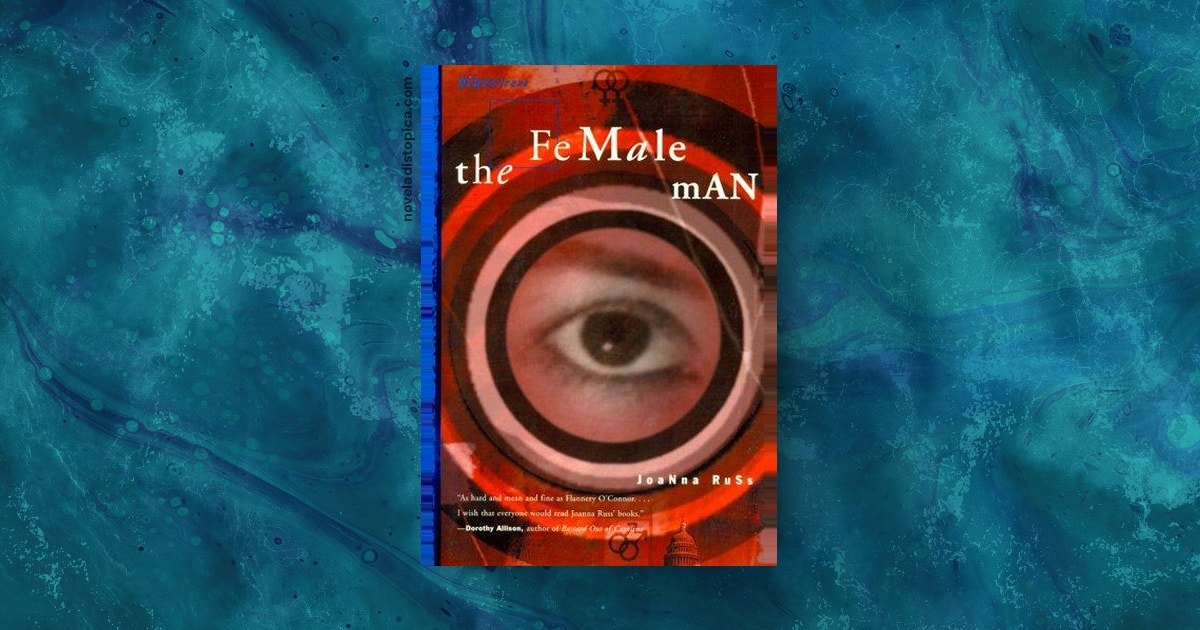
✍️ Author: Joanna Russ
📅 First published: 1975 (Bantam Books, New York); begun in 1969
🏢 English edition: Beacon Press, 2000 (US) · Gollancz SF Masterworks (UK; 2010, reissued 2022)
🔢 ISBN: 978-0-8070-6299-9 (Beacon Press)
📚 Genre: Feminist science fiction · parallel worlds · satire
📄 Pages: 224
🏆 Awards: Nebula Award nominee, Best Novel (1975) · Retrospective James Tiptree Jr. Award (1995)
🎬 Adaptations: None
⭐ Rating: 8.5/10
The Female Man by Joanna Russ (1975) follows four women from four parallel worlds, Jeannine, Joanna, Janet and Jael, who are versions of the same woman shaped by different histories. It is the founding novel of feminist science fiction: angry, often very funny, and built to break the rules of linear storytelling. Our rating is 8.5/10. Essential, but it asks for some work.
This review covers what the book is about without spoilers, who the four J’s are, what Whileaway is, the key themes, where the novel shows its age and whether it is still worth reading.
Spoiler level of this review: we explain the four worlds, what each one does and the main conflicts, but not the final decisions or how the women’s encounter ends.
The Female Man summary (no spoilers)
Janet Evason comes from Whileaway, a far-future Earth where the men died out centuries ago. She drops into a version of New York where the Great Depression never ended, and there she meets Jeannine Dadier, a librarian who is waiting to get married because nothing else seems to be on offer. Janet then crosses into a world much like the United States around 1970, home to Joanna, a feminist trying to make her way in a world run by men.
Janet is the visitor everyone wants to look at. She gives a television interview that gets cut off the moment she starts talking about how children are made on Whileaway. She goes to a cocktail party where she does not know the rules of flirtation and has no intention of learning them. Then she asks to live with an ordinary American family. Her calm, physical self-confidence is both the joke and the point: what counts as normal on Whileaway reads as outrageous in Joanna’s world.
Russ builds Whileaway into the book through mock histories, interviews and anecdotes. One section opens: «The first man to set foot on Whileaway appeared in a field of turnips on North Continent.» The tone is deadpan, and the sentence does a lot of work. On Whileaway, a man is the alien.
Later the three meet a fourth woman, Jael, from a world where men and women have been at open war for forty years. She is the one who has brought them together, and she has her reasons. Those reasons are the novel’s final turn, and they are better met on the page.
Plot is not really the engine, though. The book is arranged in nine parts and jumps between narrators, times and registers: scenes, monologues, lists, dialogue set out like a play, essays aimed straight at the reader. The question is never which world is right. It is what each world reveals about the others, and what a woman becomes when the world around her changes.
Who are the four J’s in The Female Man?
Each J is the same woman raised under different conditions. That is the novel’s central device, and it lets Russ treat gender as a variable rather than a fact of nature.
- Jeannine Dadier is a librarian in a New York stuck in the Depression. Marriage is her only plan, and she half knows it is not much of one. She is the most passive of the four and, by design, the hardest to like.
- Joanna lives in a world much like America around 1970. She is the narrator closest to Russ herself, an educated woman who has learned that to be taken seriously she has to become «a man» in everything but body. Her transformation gives the book its title.
- Janet Evason is from Whileaway. She is strong and direct, married to a woman named Vittoria, and baffled by almost everything Joanna’s world treats as natural.
- Jael (Alice Jael Reasoner) comes from a world split into Manland and Womanland. She works as an assassin, and she is the darkest and most memorable of the four.
A practical tip for first-time readers: the narration does not always tell you which J is speaking. If you lose track, look at what the speaker finds strange. That usually gives her away.
Key themes in The Female Man
The novel’s ideas and its form are hard to separate, which is where both its strength and its difficulty come from.
Whileaway: a utopia with sharp edges
Whileaway is the book’s best-known invention. Russ had already used it in the short story «When It Changed» (1972), which won the Nebula. In the novel it is Earth some ten centuries ahead, where, according to its histories, a plague killed the men, and women have children by merging their ova. It is rural and highly technological, and it is organized around safety rather than equality. People work hard, raise children, travel, and settle serious quarrels by dueling.
Russ does not offer it as paradise. The work is relentless, violence has not disappeared, and Janet is not gentle. The argument is not that women are naturally peaceful. It is that, with no men setting the terms, nobody on Whileaway has been trained to apologize for taking up space. Put next to Joanna’s world, that difference is hard to unsee. And Russ keeps the distance in view: «Whileaway, you may gather, is in the future.» Whatever it offers, it is not available now.
What «female man» means
The title comes from Joanna. In a culture where «man» is the default human and «woman» a special case, she finds that the only way to be treated as a full adult, with a career, opinions and the right to be listened to, is to think of herself as a man. She stays a woman. She simply joins the category her culture reserves for people who count.
This is not a story about gender transition in today’s sense, and reading it that way misses the point. The phrase is a joke with a blade in it. It exposes the false neutrality of the word «man,» in the same way the novel takes apart the habits of conversation, work and courtship that keep women polite and small.
A novel that refuses to behave
The main difficulty of The Female Man is not its vocabulary but its voice. An «I» can change hands from one section to the next. A scene can break off before you know where you are. An essay can cut into a conversation. Russ does this on purpose: she refuses the reader a neutral narrator standing above the four worlds, because she does not believe such a narrator exists.
It helps not to build a perfect timeline on a first reading. Track who is speaking, which world she comes from and what she notices about the others. Some repetitions are not continuity errors but variations on one identity under pressure. And much of the book is funny. Its satire of the ways women’s complaints get brushed aside has dated far less than you might expect from a novel written around 1970.
Where it falls short
Its idea of «woman» is often too unified. Race and class barely register, and the binary of men against women leaves little room for what later feminism has had to say about trans and non-binary lives. That does not make the novel irrelevant, but it makes it a historical text that argues with the present, not a full account of it.
Most of its men are flat. That works as satire, an inversion of decades of science fiction in which women were scenery, but as psychology it is thin. The pacing is uneven too: sharp scenes sit next to passages that read like notes from a private argument. Anyone expecting a parallel-worlds thriller will feel misled. And Jael’s violence still divides readers, which Russ fully intended.
Context and legacy
Russ began the novel in 1969 and had finished it by 1971, but it took years to find a publisher. It finally appeared in February 1975 as a mass-market paperback from Bantam, in Frederik Pohl’s science fiction line. The delay matters. The book grew out of second-wave feminism and out of a science fiction field still dominated by men, and it makes no attempt to hide its position behind a neutral allegory.
It was a Nebula finalist for Best Novel and, two decades later, received the 1995 Retrospective James Tiptree Jr. Award together with «When It Changed.» In the jury’s notes, one member recalls a male friend calling it «articulate rage,» which is about as compact a description as the book has had. For the wider arc of Russ’s career, the Encyclopedia of Science Fiction entry is the best single place to start.
Its influence runs through the feminist and queer science fiction that followed, which increasingly treats gender as something a society builds rather than something a body dictates. Half a century on, the novel is in print in the US from Beacon Press, in the UK in Gollancz’s SF Masterworks series, and in the Library of America volume Joanna Russ: Novels & Stories, edited by Nicole Rudick.
If you liked The Female Man
- The Dispossessed (1974), Ursula K. Le Guin. Two societies set against each other so that neither looks perfect. The closest match in political seriousness.
- The Left Hand of Darkness (1969), Ursula K. Le Guin. Gender as a thought experiment, and another of the Tiptree retrospective winners.
- Herland (1915), Charlotte Perkins Gilman. The all-female utopia that Whileaway partly answers. Reading the two side by side shows how far Russ moved the idea.
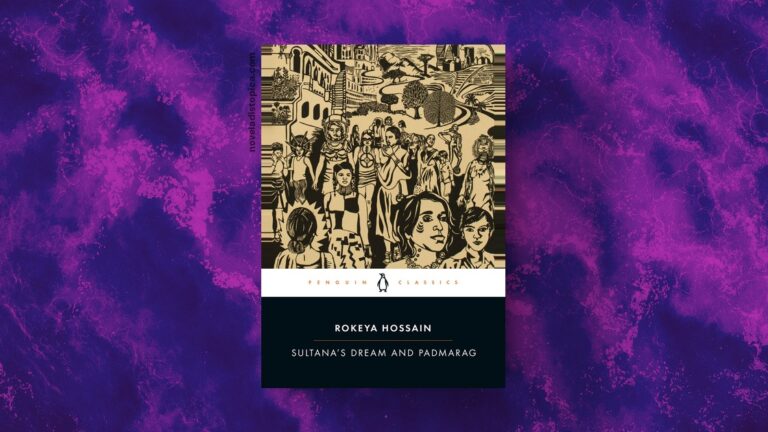
- Sultana’s Dream (1905), Rokeya Sakhawat Hossain. Ten years before Herland, a Bengali writer turned purdah inside out and locked the men indoors. The shortest and funniest of the early feminist utopias.
- Woman on the Edge of Time (1976), Marge Piercy. The nearest companion in ambition: a utopian future seen through the eyes of a woman the present has crushed.
- The Handmaid’s Tale (1985), Margaret Atwood. The reverse image: a regime that turns women’s bodies into state property.
Who should read it
Read it if you are interested in feminist science fiction, gender theory or experimental fiction; if you enjoyed the rival societies of The Dispossessed or Herland; or if you are studying the book and want to see why it keeps turning up on syllabi.
It is not the right book if you need a stable narrator, step-by-step explanations or an adventure driven by suspense. Nor should you expect its 1970 feminism to settle today’s debates. Its value lies in the break it made and in the questions that still sting.
Verdict: is The Female Man worth reading?
Yes, with caveats. The Female Man does not ask permission and does not always make itself easy to read, and that resistance is part of its force. Russ shows that imagining another world is not only a matter of changing laws or technology. It means changing who gets to speak, which story passes for normal and which desires seem possible.
Its blind spots are real and its structure will not suit everyone. Even so, few novels make it this plain that gender is a story a society tells long before it starts to look like nature. Rating: 8.5/10. An uncomfortable classic, best read with some context, close attention and a willingness to argue back.
About Joanna Russ
Joanna Russ (1937–2011) was born in the Bronx, studied at Cornell and at the Yale School of Drama, and spent most of her career teaching, from 1977 at the University of Washington. She won the Nebula for «When It Changed» and, in 1983, the Hugo for the novella «Souls.» Her other fiction includes the Alyx stories and We Who Are About To… (1977).
She mattered as much as a critic as she did as a novelist. How to Suppress Women’s Writing (1983) is still read as a field guide to the ways women’s work gets dismissed, and To Write Like a Woman (1995) collects her essays on feminism and science fiction. She received the Pilgrim Award for criticism in 1988, entered the Science Fiction and Fantasy Hall of Fame in 2013 and was given SFWA’s Solstice Award, posthumously, in 2015. She died in Tucson, Arizona, in April 2011; Locus‘s obituary remembered her chiefly for The Female Man.
Frequently asked questions
What is The Female Man about?
It is about four women from four parallel worlds, Jeannine, Joanna, Janet and Jael, who meet and compare their lives. Because they are versions of the same woman, their differences show how much of womanhood is produced by society: work, desire, independence and violence all change as the world around each J changes.
Who are the four J’s in The Female Man?
Jeannine is a librarian in a world where the Great Depression never ended. Joanna lives in a world like 1970s America. Janet comes from Whileaway, an all-female future Earth. Jael is an assassin from a world where men and women have been at war for forty years.
What does the title The Female Man mean?
It refers to Joanna’s decision to think of herself as a man, in mind if not in body, because her world treats only men as full, competent adults. The title attacks the idea that «man» is a neutral word for «human being.»
Is Whileaway a utopia?
Partly. Whileaway has no men and no sexual violence, and women fill every role in society. But it is demanding and sometimes violent, and the novel questions how it came to exist. Russ uses it as a contrast rather than a finished answer, which is why The Female Man is read as both utopia and dystopia.
Is there a movie of The Female Man?
No. There is no film or TV adaptation of The Female Man. The novel is available in print from Beacon Press in the US and Gollancz in the UK, and as an ebook.
Whileaway is still in the future, as Russ warned, and the argument she started is still going. Our other English-language reviews of dystopian and utopian classics are collected on the Reviews in English page.