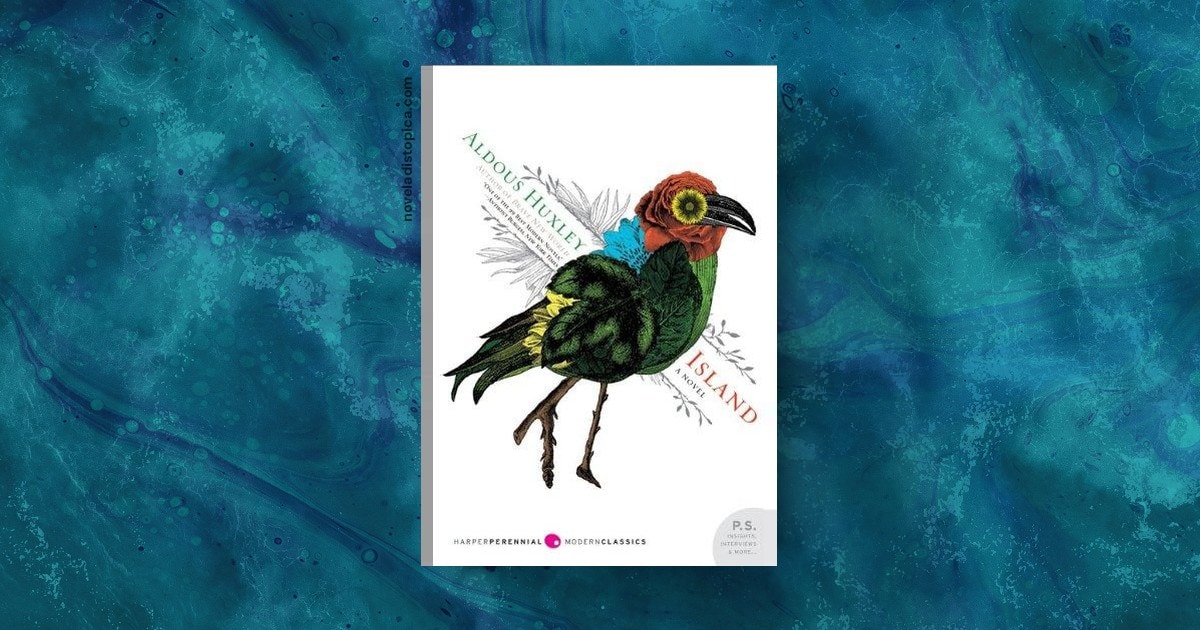
✍️ Author: Aldous Huxley
📅 First published: 1962 (Chatto & Windus, London; Harper & Brothers, New York)
🏢 English edition: Harper Perennial Modern Classics, 2009 (US) · Vintage Classics (UK)
📄 Pages: 384 (Harper Perennial Modern Classics)
🔢 ISBN: 978-0-06-156179-5
📚 Genre: Utopian fiction · novel of ideas · philosophical science fiction
🏆 Awards: —
🎬 Adaptations: None released; a TV series from Leonardo DiCaprio’s Appian Way was announced in 2020
⭐ Rating: 9/10
In Island, Aldous Huxley imagined the mirror image of Brave New World: Pala, a small island nation in the Indian Ocean, off Sumatra, where Western medicine and Mahayana Buddhism have worked together for a century to keep a society sane, unarmed and awake. Their tool is a drug that sharpens perception instead of dulling it. It came out in 1962 and was his last novel. Huxley died the following year.
Most readers know Huxley for the nightmare and never get to his dream. Below: the plot without spoilers, how Pala works, what moksha-medicine is, how the book answers Brave New World and, in a separate section with a warning, the ending explained.
Island summary (no spoilers)
Will Farnaby is an English journalist who has made a career of sneering. He works for Lord Aldehyde, a magnate with oil interests, and has a quiet assignment: get into Pala, the «forbidden island» that keeps reporters out, and smooth the way for his employer to get his hands on the oil under it. He sails alone from Rendang-Lobo, on the neighboring island of Rendang, runs into a squall and wrecks his boat on the only beach along a coast of cliffs. Climbing in the dark, he is startled by a snake, falls, and comes to injured in the forest.
The first thing he hears is a bird. The novel opens with it: «‘Attention,’ a voice began to call, and it was as though an oboe had suddenly become articulate.» It is a trained mynah, and its other phrase is «Here and now, boys» (both quoted from the Harper Perennial Modern Classics edition). The second thing he meets is a girl of about ten, Mary Sarojini, who does not pity him. She makes him describe the fall again and again until the fear wears out. It is his first lesson in how Pala works. She and her brother, Tom Krishna, fetch their grandfather, Dr. Robert MacPhail, who takes Will in.
While he recovers, Susila MacPhail, the children’s mother, treats him with hypnosis, and Will starts to see how the island lives. Children grow up among several families. Sex carries no guilt. The dying are accompanied, not hidden. And all of education turns on something as simple, and as hard, as paying attention.
The threat is in plain view from the first chapters. The Rani, the queen mother, and her son Murugan, who will soon take the throne, were raised outside Pala’s culture and want to «modernize» it. Across the strait, Colonel Dipa, the military ruler of Rendang, eyes Pala’s oil as greedily as Lord Aldehyde does. And Will, sent to help sell the island, begins to suspect he no longer wants to close the deal. Island is not the story of a triumphant utopia but of a fragile one, surrounded by a world that cannot stand its existence.
Key themes in Island
Huxley builds Pala piece by piece, mostly through conversation, and those pieces hold both the best and the weakest parts of the book.
Pala, a society that chooses its technology
It all began, Dr. Robert explains, with his great-grandfather, Dr. Andrew MacPhail, a Scottish surgeon called to the island more than a century earlier to remove a tumor from the face of the reigning raja, and who used hypnosis in place of anesthetic. From his alliance with that Buddhist king, the «Raja of the Reform,» came a program of government: take what is useful from the West, what is wise from the East, and nothing else. A later ruler, the Old Raja, set the philosophy down in a treatise, Notes on What’s What, and on What It Might Be Reasonable to Do about What’s What, which Will reads as he recovers: a book within the book.
The result is a society that does not reject science but selects it. Pala has hydroelectric power to keep food cold, good medicine and modern farming, but no heavy industry, no army and no hurry to grow. Children belong to Mutual Adoption Clubs, groups of families in which every child has many adults to turn to when their own parents fail them. School teaches science alongside control of the body and the habit of looking at one’s own fears. Sex is treated as a practice of awareness, maithuna, which the book calls «the yoga of love.» The outside world Pala refuses to copy gets one dry line: «Armaments, universal debt, and planned obsolescence—those are the three pillars of Western prosperity.»
Moksha-medicine: soma in reverse
Pala’s most famous invention is moksha-medicine, a psychedelic derived from a yellow mushroom and taken at set moments in life, such as the rites of passage of the young. It is used with a guide, in a ritual setting, to reach an experience of unity with everything that exists and to come back from it seeing more clearly. Moksha is the Sanskrit word for liberation.
This is where Island talks back to its famous older sibling. The soma of Brave New World was a drug for feeling nothing; moksha is a drug for feeling everything. Between the two novels, Huxley had taken mescaline in 1953 under the supervision of the psychiatrist Humphry Osmond and written about it in The Doors of Perception (1954). The chemistry he saw in 1932 as the perfect tool of control looked, thirty years later, like a possible door to lucidity. The scene in which Will finally takes it is among the best things Huxley wrote.
«Attention»: Huxley’s practical Buddhism
The mynahs that call «Attention» and «Karuna» (Sanskrit for compassion) all over the island sum up Pala’s religion better than any sermon. It is Buddhism without dogma or miracles, reduced to a practice: be where you are, see what is happening, and do not run from pain. Mary Sarojini’s session with Will in the forest is the whole method in a few pages. That we now sell it in apps as mindfulness shows how far the idea traveled, and how much it lost on the way.
The approach works on the page because Huxley presents it as mental hygiene, not faith. In one well-known scene, Will watches a children’s puppet play, Oedipus in Pala, in which the story ends happily. When he points out that in Sophocles Oedipus blinds himself, the children find it absurd: he only needed to stop being married to his mother. That is how Pala reasons.
Where it falls short
As a novel, Island shows its seams. Whole chapters are lectures with scenery, and several characters, starting with Dr. Robert, exist mainly to explain things to Will. Critics said so at the time. Kirkus read it as more treatise than fiction, with the plot interrupted by essays. Frank Kermode, in Partisan Review (1962), went further and called it «one of the worst novels ever written»: a sane, happy society, he argued, left Huxley without the disgust that powered his best fiction. The Palanese are also right about everything, on schedule, which wears thin.
Some things have aged badly. Pala practices a soft eugenics, voluntary artificial insemination from selected donors, presented without a hint of doubt. Its view of Asia sometimes reads like a postcard written in California. Kermode was right about the craft and wrong about the book: what fails is the novel, not the question, and the question is still one of the best that utopian fiction has asked.
Island vs Brave New World: the same ingredients, reversed
Huxley proposed this comparison himself. In the foreword he wrote in 1946 for a new edition of Brave New World, he admitted that if he rewrote the book he would offer the Savage a third option, between the World State and the reservation: a decentralized, cooperative community, with science serving people instead of enslaving them. Sixteen years later, that community had a name.
Pala is built from the same materials as the World State, used for the opposite purpose:
| Element | Brave New World (1932) | Island (1962) |
|---|---|---|
| The drug | Soma, to stop feeling and obey | Moksha-medicine, to see more clearly |
| Child-rearing | Conditioning centers, no family | Mutual Adoption Clubs, many families |
| Trance | Hypnopaedia, to indoctrinate during sleep | Hypnosis, to learn and to heal |
| Reproduction | Bottle-grown babies, engineered for their caste | Voluntary artificial insemination |
| Sex | A compulsory pastime that distracts | A practice of awareness (maithuna) |
| The voices | State slogans and loudspeakers | Birds that say «Attention» |
Taken together, the two novels make the same argument from opposite sides: technology is neither good nor bad, and everything depends on what it is for and who decides. Laura Huxley, his second wife, described the pair along the same lines in a later interview, with the first book as a warning and the second as an offering.
Island ending explained (spoilers)
Warning: this section gives away the ending. If you have not read the novel, skip to the verdict.
By the last chapters Will has changed sides. Susila has helped him face his past, including his guilt over the death of his wife, Molly. Lakshmi, Dr. Robert’s wife, is dying of cancer, and one night the Rani summons Will to close the oil deal. He does not go. He goes to Lakshmi’s bedside instead and witnesses a conscious, accompanied death, surrounded by her family. It is the emotional center of the book.
Afterwards, Susila gives him moksha-medicine. Will goes through an experience in which the self dissolves into the unity of everything, and he also watches a praying mantis devour its mate: the horror and the beauty of the world, together and unfiltered. At dawn there is gunfire. Over loudspeakers, Murugan calls for calm and proclaims what is «to be known henceforth as the United Kingdom of Rendang and Pala,» with himself as king and Colonel Dipa as prime minister. The column of soldiers stops long enough to kill Dr. Robert and moves on. In the final lines, a mynah calls out once more: «Attention.»
What did Huxley mean? That a sane society cannot defend itself with weapons against insane neighbors without ceasing to be what it is. Pala falls because of its oil and the ambition of a boy who is not yet king. But the ending says more than «utopia is impossible.» Will reaches clarity at the moment the island is lost, and the bird keeps talking. The utopia dies as a state but survives as a practice: attention cannot be invaded. It is a bitter ending, and possibly the only honest one.
Why Huxley wrote Island
He had been preparing it for decades. From the 1940s on, his essays gathered nearly everything Pala contains: mysticism, decentralization, birth control and psychedelics. The last chapter of Brave New World Revisited (1958) already proposed ways to stop a democracy from ending up like the World State. Island is the fictional version of that program.
He also wrote it against the clock. His first wife, Maria Nys, died in 1955, and in 1960 he was diagnosed with laryngeal cancer. On May 12, 1961, with the novel nearly finished, a brush fire in the Hollywood Hills destroyed his house, his library and almost all his papers. Huxley and his second wife, Laura Archera, got out with very little, but they saved the manuscript of Island. The book appeared in 1962, from Chatto & Windus in London and Harper in New York.
There is a final echo that is hard to ignore. On November 22, 1963, no longer able to speak, Huxley asked Laura in writing for an injection of LSD, 100 micrograms, and died that afternoon in Los Angeles. It is difficult not to think of moksha and of Lakshmi’s death.
Who should read Island, and what to read next
Read it if you like utopias and want one that takes its own fragility seriously, or if Brave New World left you wondering what the alternative was: this is its author’s answer. It also suits readers interested in Buddhist thought or in the psychedelic debate, now back in mainstream medicine.
Think twice if you want action and twists: Island moves slowly and stops often to explain. If novels of ideas bore you, start with Brave New World and come back to Pala when you feel like arguing.
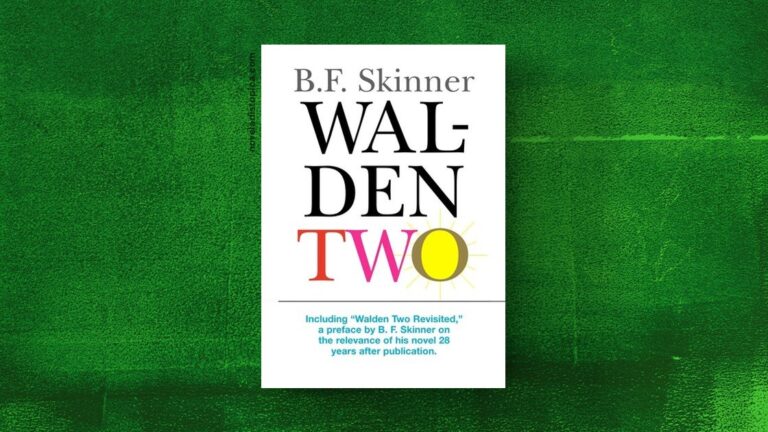
If you liked Island, Ursula K. Le Guin’s The Dispossessed is the great utopia that shows its cracks. B. F. Skinner’s Walden Two is the third corner of the triangle: another community that raises its children by design, with no mysticism at all. Ernest Callenbach’s Ecotopia takes Huxley’s ecological instinct further. And Huxley’s own The Doors of Perception is the nonfiction source of moksha.
Verdict: is Island worth reading?
Yes. Island is one of the richest and most honest utopias of the twentieth century, and the essential half of Huxley that few people read. It gathers in one book everything its author thought about for thirty years, and it does not cheat: the good society exists, it works, and it still loses. Its weaknesses are chapters that turn into lectures and characters who are sometimes there only to explain, but few novels leave you with as much to think about.
Rating: 9/10. More essay than novel in places, which is exactly why it rewards a second reading.
About Aldous Huxley
Aldous Leonard Huxley was born on July 26, 1894, in Godalming, England, into a family of scientists; the biologist Thomas Henry Huxley was his grandfather. An eye infection in 1911 left him nearly blind and ended his plan to study medicine. He read English at Balliol College, Oxford, made his name with satirical novels and in 1932 published Brave New World, the model for much of the dystopian fiction that followed.
From 1937 he lived in California, where he wrote for Hollywood and moved from youthful skepticism toward mysticism, Eastern philosophy and psychedelics. He died in Los Angeles on November 22, 1963, the same day as John F. Kennedy and C. S. Lewis. His last novel was a utopia, not another warning, which says a lot about how the man who taught readers to fear the future chose to sign off.
Frequently asked questions
What is Island by Aldous Huxley about?
Island (1962) follows Will Farnaby, a cynical English journalist who is shipwrecked on Pala, a utopian island in the Indian Ocean, off Sumatra, where Western science and Mahayana Buddhism have coexisted for a century. He has come to help an oil magnate, but finds a peaceful, sane society about to be invaded by the military ruler of the neighboring island.
How does Island end?
Spoiler warning: Island ends with the fall of Pala. On the night Will takes moksha-medicine, Colonel Dipa’s troops invade with the help of young Murugan, who proclaims himself king of the United Kingdom of Rendang and Pala. The soldiers kill Dr. Robert MacPhail, and the novel closes with a mynah calling «Attention.»
Is Island a sequel to Brave New World?
No. Island is a standalone novel with different characters and setting, but Huxley wrote it as the positive counterpart to Brave New World. It answers the 1932 nightmare with the same elements used in reverse: drugs, collective child-rearing, hypnosis and assisted reproduction. Reading both is the best way to see what he was arguing.
Was Island Aldous Huxley’s last novel?
Yes. Island was the last novel Aldous Huxley published. It appeared in March 1962, and he died in Los Angeles on November 22, 1963, after a long illness. He had saved the manuscript from the fire that destroyed his house in May 1961.
Is there a movie of Island?
No film or series of Island has been released. In 2020 Leonardo DiCaprio’s company, Appian Way, was reported to be developing a TV adaptation with In Good Company Films, but it has not reached the screen.
With Island, Huxley closed the circle he had opened in 1932: first the comfortable cage, then the garden nobody managed to defend. The rest of the shelf is on our page of dystopian and utopian classics reviewed in English.